About
Typography is at a crossroads. As artificial intelligence (AI) reshapes creative disciplines, designers must navigate a landscape where machine-generated design is becoming increasingly sophisticated. Font Flow: Typographic Experimentation in the Age of AI explores the evolving relationship between human intuition and computational precision through the material language of typography.
Too Many Choices, Too Little Guidance
The abundance of digital fonts, while a testament to technological progress, has created new challenges for designers:
Motivations for Font Flow
- Creative stagnation – With thousands of fonts available, designers often default to familiar pairings rather than explore innovative combinations.
- Lack of exposure to diverse typefaces – Lesser-known, high-quality fonts often remain undiscovered due to inefficient search and categorization methods.
- Typography education gaps – Current instruction in typography prioritizes historical and anatomical understanding but offers little guidance on pairing strategies.
Faced with these challenges, graphic designers need a tool that encourages exploration and helps them break free from habitual choices.
Prompt-Based Experimentation
Font Flow is designed to challenge designers by providing structured yet unexpected font pairings for typographic posters. Informed by research into ideation tools such as TypeCooker and Sharpen, the Font Flow platform presents randomized constraints that push designers beyond their comfort zones.
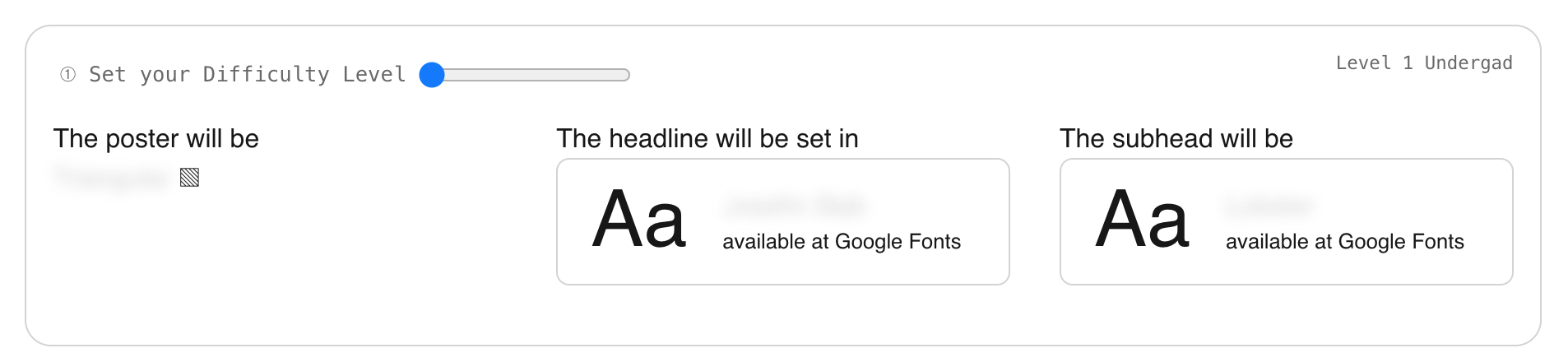
User-Selected Complexity
- Controlled randomness – You can increase or decrease the level of complexity of the prompt.
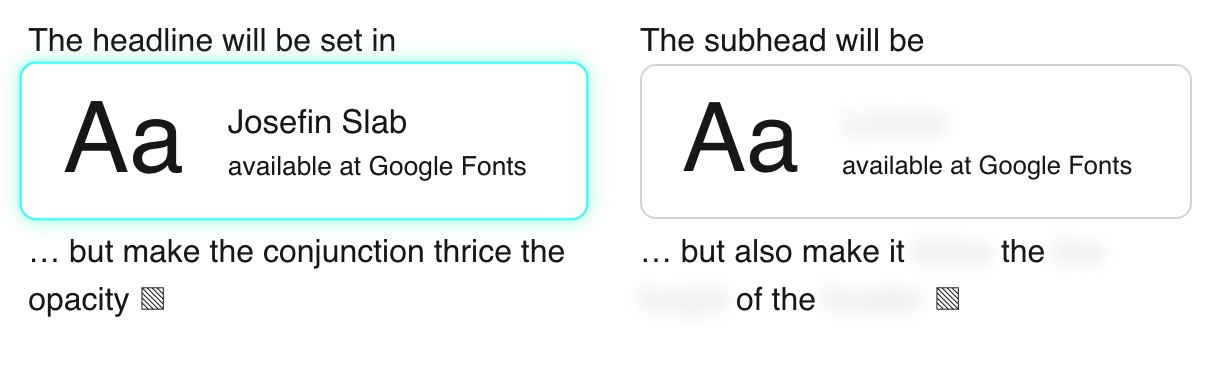
Creative Friction
- Higher difficulties, deeper challenges – At higher difficulties, the headline and subhead fonts include formal typography adjustments based on linguistic or content relationships. These added requirements will push you to be more creative in your typography.
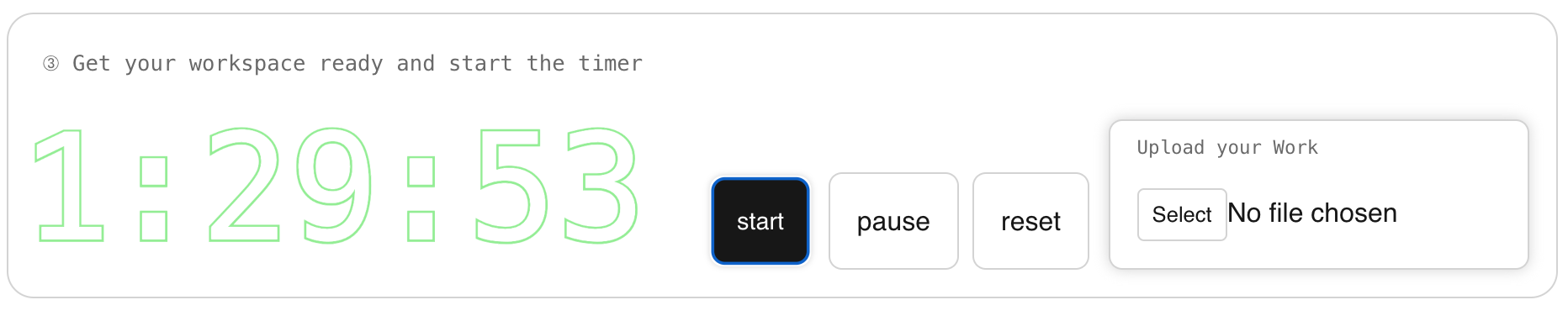
An Aid Against Procrastination
- Time constraints – The timer aspect of the site encourages more creative thought by imposing a 90-minute limit on your sessions.
This methodology mirrors the problem-solving nature of design, forcing practitioners to rethink how typography functions within composition.
How Font Flow Enhances Learning
Font Flow is designed to be a long-term tool for typographers and designers. The user interface (UI) and user experience (UX) are crafted to facilitate deep engagement.
UX and UI Considerations
- Minimalist, distraction-free design – Encourages focus on typography rather than unnecessary UI elements.
- Immediate feedback on constraints – Adjusting the challenge level selector provides real-time updates on the complexity of your design sprint session.
- Community infrastructure – The gallery section of Font Flow fosters stronger critical and analytical skills as users review and compare designs.
Beta Testers Try Out Font Flow
Beta testers—Hrant H Papazian, Miguel Escamilla, Kateryna Kovalevska, and others—engaged in a timed design sprint, each responding to a randomized typographic prompt. Like the beta testers, when you upload work to the gallery section, Font Flow generates a design with the same prompt using Ideogram 2.0's API. When both designs appear in the gallery, author attribution is removed.
Explore the Gallery to See Which Designs Are AI- or Human-Made
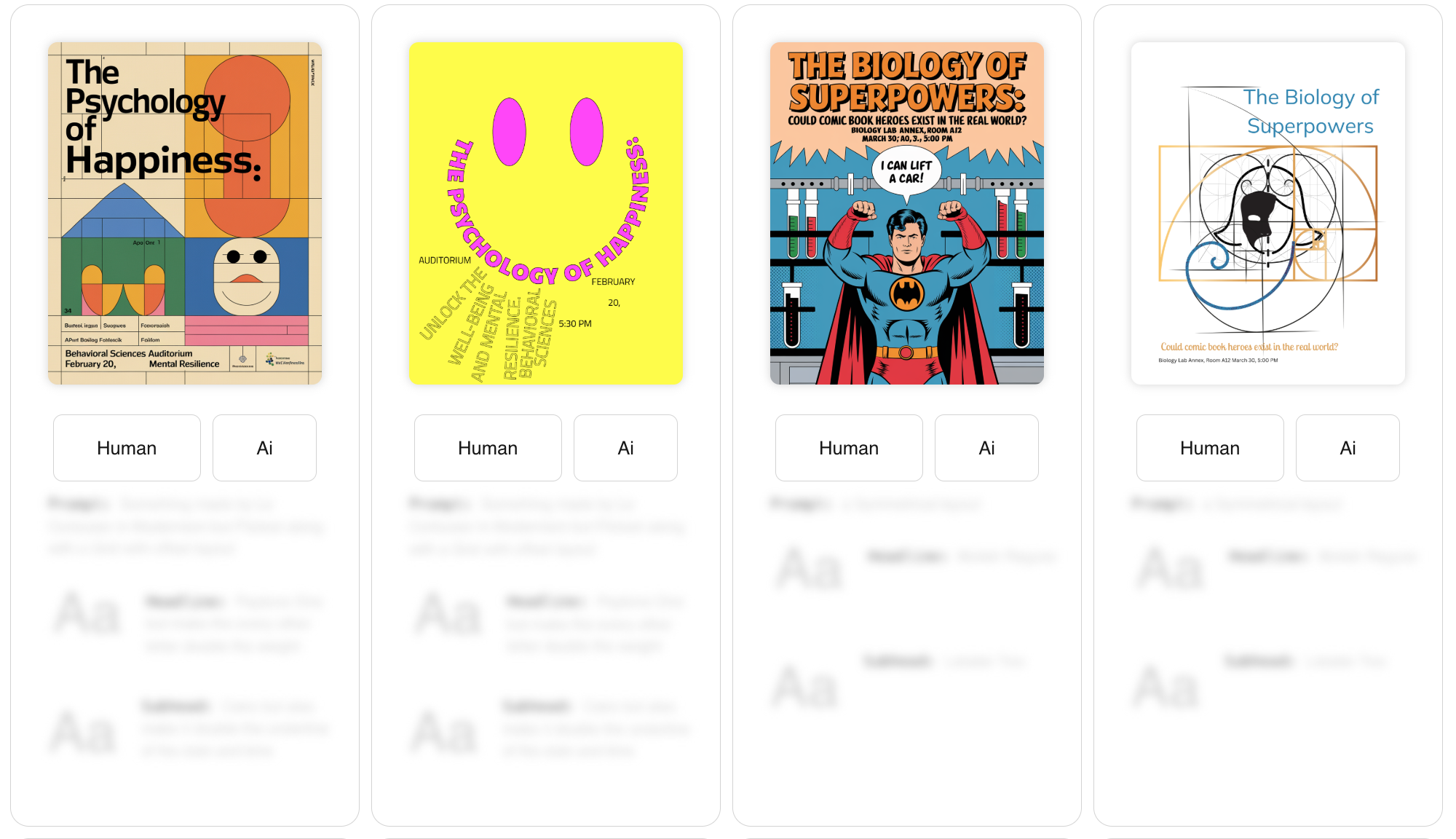
Reported Experiences
The gallery section prompts viewers to distinguish between human- and AI-made designs, raising critical questions about authorship, creativity, and the evolving role of AI in graphic design. Can machines truly replace the human touch in typography? What does it mean to create something uniquely human in a world where AI can mimic stylistic decisions? Beta testers were often surprised when they misattributed AI- and human-made work.
User 1
Moments where I missed the design as AI when there were clear markers of it.
User 2
The part that hit the nail on the head was AI vs. human-crafted.
User 3
It was harder to find what was AI and what was human! I was like, damn, it fooled me good.
User 4
Many of my guesses (human vs. AI) were wrong, and I realized that first impressions are not enough. One has to carefully study a piece for clues.
User 5
I thought some of the posters were made by humans, but they were AI! And vice versa.
AI vs. Human Typography: A Review Study
To further explore the relationship between AI and human creativity in typography, a small review study evaluated the effectiveness and quality of the designed posters.
Method
- 20 designers participated, rating AI-generated and human-made designs side by side. Ten were professional designers; ten were design students.
Each artifact was reviewed according to four criteria:
Used Fonts
Are the fonts in the design the ones assigned in the prompt?
Content Clarity
Is the content of the university lecture understandable to the viewer?
Location Accuracy
Are the time, place, and location of the lecture clear?
Visual Interest
Rated on a scale of 1 to 5.
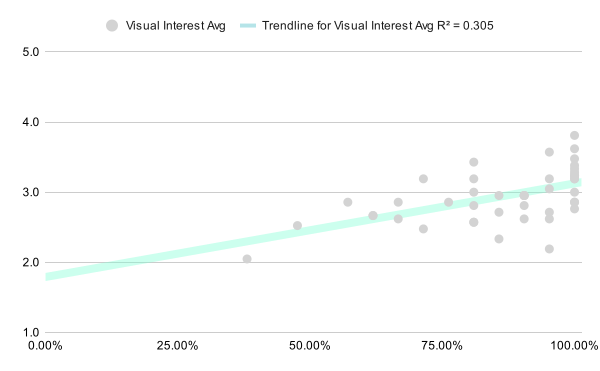
Visual Interest and Content Correlation
- There is a moderate correlation (0.55) between the average visual interest and the clarity of the content in the poster.
- However, the R-squared value for the interaction between average visual interest and content clarity is 0.3, meaning 30% of the variation in visual interest can be explained by content clarity. The remaining 70% is attributed to other factors.
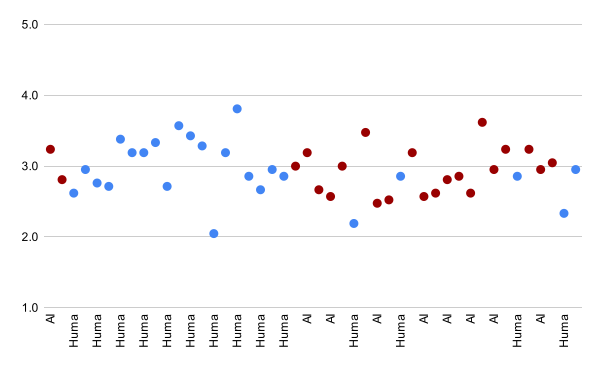
Visual Interest and Origin Correlations
- There is a weak correlation (0.22) between the average visual interest score and whether the artifact was created by the author, Thomas Jockin.
- There is practically no correlation (0.009) between average visual interest and whether the design was AI- or human-made. Reviewers rated AI and human designs similarly in terms of visual interest.
Human vs. AI Visual Interest
- There is almost no difference in visual interest between human- and AI-made designs. The average human-made design received a rating of 3.0, while AI-generated designs received an average rating of 2.9.
Head-to-Head Comparison
- However, when directly comparing human- and AI-made designs using the same prompt, human-made designs won 8 out of 9 times. This is because none of the Ideogram-generated posters used the required fonts, whereas all human participants met this criterion.
These results suggest that AI models are not yet precise enough to adhere to typographic parameters that most human designers can follow. However, as LLMs trained specifically on typography emerge, this conclusion may change.
On the other hand, AI-generated designs already serve as a benchmark measure for visual creativity in typography. Practitioners and students can use AI-generated work in Font Flow as a reference to refine their own typographic creativity.
Ready to Challenge Yourself?
Push your creativity further by using Font Flow’s typography prompts yourself.
Typography is Evolving
- Visit Font Flow to generate your own font pairings, experiment with new ideas, and join a community of designers redefining typography.
Closing Remarks from the Author
Font Flow is part of the author's MFA thesis at Liberty University, Nudging Creativity in Typography with Font Pairing Prompts.
I hope this website sparks insightful conversations among designers and technologists interested in material culture and creativity. You can read the full research in the thesis PDF. Thank you for exploring Font Flow!
Special Thanks
- Thesis Committee: Professors Rebekah Cochell and Giovanni Montoya for their invaluable feedback.
- Mentors & Friends: Micah Rich for coding mentorship and Kateryna Kovalevska for testing prototypes.
- My Parents: Thank you for your unwavering love and support.